
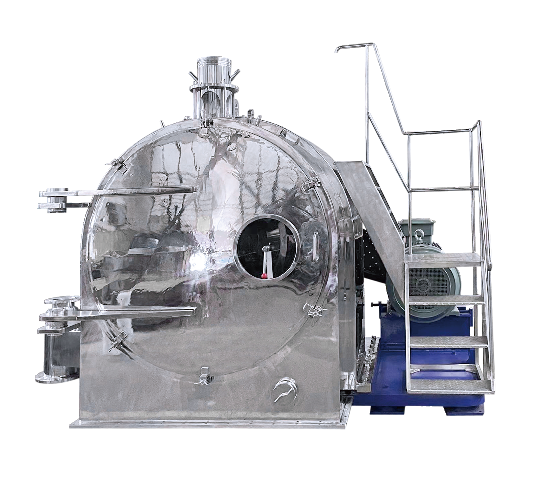
LWL-CX Horizontal Screen Scroll Centrifuge

Product Description
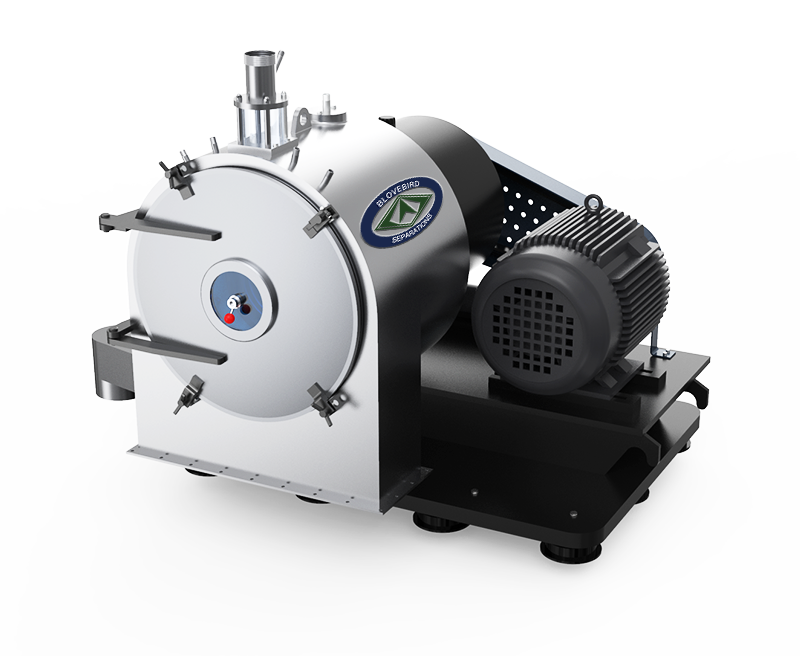
The LWL-CX horizontal screen scroll centrifuge is an improved upgraded version of LWL model, designed for continuous mass production separation. The entire series adopts a planetary differential with higher torque, all lubricated with circulating lubricant and long oil change intervals, and the whole series adopts a plate heat exchanger for cooling, which increases the cooling efficiency by five times compared with the LWL series.
Blovebird’s pioneering planetary differential with recirculating lubrication:
The existing market is either a cycloidal differential with built-in recirculation lubrication or a planetary differential with rear-mounted oil bath lubrication. The disadvantage of the former is the low torque, while the disadvantage of the latter is that it is difficult to completely drain the worn metal chips from the differential and increases the complexity of the machine structure. In the CX series, Blovebird adopts the planetary differential with built-in circulation lubrication, which has high torque, thorough lubrication, no debris residue, simple structure of the whole machine, stable equipment and easy maintenance.

Quick Disassembly

Compact Design

General Filtration

Smooth Operation

Simple Structure

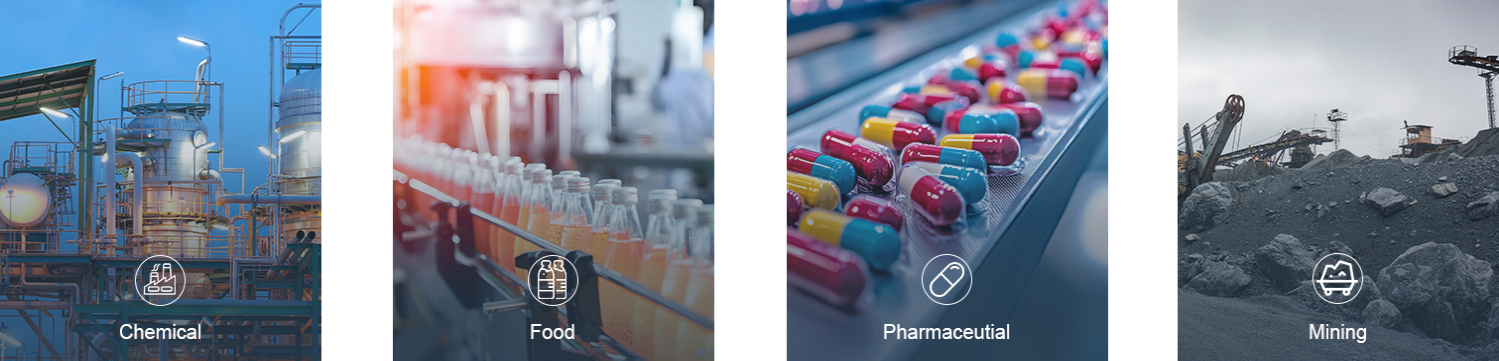
Application Industry

Application Cases
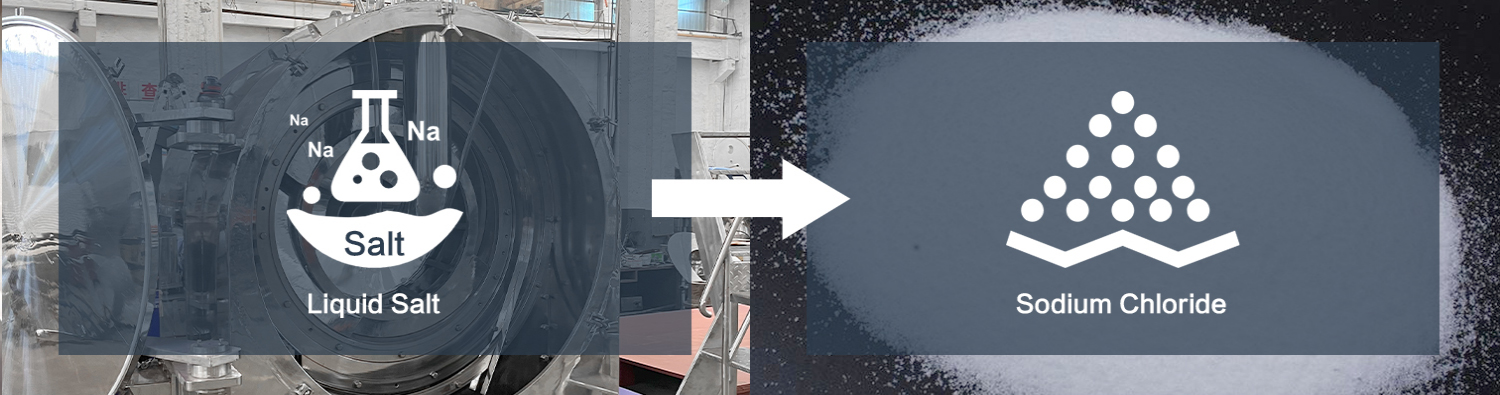
Model:LWL-CX600
Separation Material: Salt Material → Product: Sodium Chloride
Operating Principle
Horizontal screen scroll centrifuge is composed of transmission system, drum parts, spiral parts, shell and lubrication system.The solid-liquid mixture flows into the machine through the central fabric tray and enters the inside of the spiral. The fabric tray inside the spiral can pre-accelerate the mother liquor and distribute it evenly to the drum.The drum and the spiral are of concentric structure and the gap between them is generally 0.8-2mm.The pre-accelerated mother liquor is further dewatered in the drum under the action of centrifugal force, and then the screw conveyor pushes out the dewatered solids.

Main Features

Throughput
Great throughput.

Load Distribution
The center of gravity support is shifted forward for more reasonable load distribution.

Planetary Differential
Adopt circulating lubrication planetary differential, more torque longer life.

Main Bearing and Differential
Including the main bearing and differential internal with circulating lubrication system,Single-arm suspension structure.

Rotation Speed of Screw and Drum
The rotation speed of the screw is slightly different from the rotation speed of the drum, which allows the product to be pushed out and distributed evenly. Insensitivity of the model to fluctuations in mother liquor concentration and other operating conditions.

Low Power Demand
The solid/liquid mixture enters the thinnest end of the bottom of the drum, where most of the liquid is separated through the screen. And in this zone, the linear velocity of the spiral blades is the lowest compared to machines of cylindrical design, so the power requirement of this model is low.

Spiral Function
Under centrifugal force, most of the solids will slide towards the maximum diameter and then be discharged from the discharge port. If the solids stick to the screen, the spiral pushes them forward, and if they slide out too quickly, the spiral holds them in the drum.

Conveying Screw
The conveying spiral acts as a control by regulating the sliding speed and residence time of the solids. If the wet solids have a low coefficient of friction, the blades hold the solids back, and near the maximum diameter end of the drum, if the dewatered solids have a high friction on the drum, the spiral pushes the solids out to the discharge.
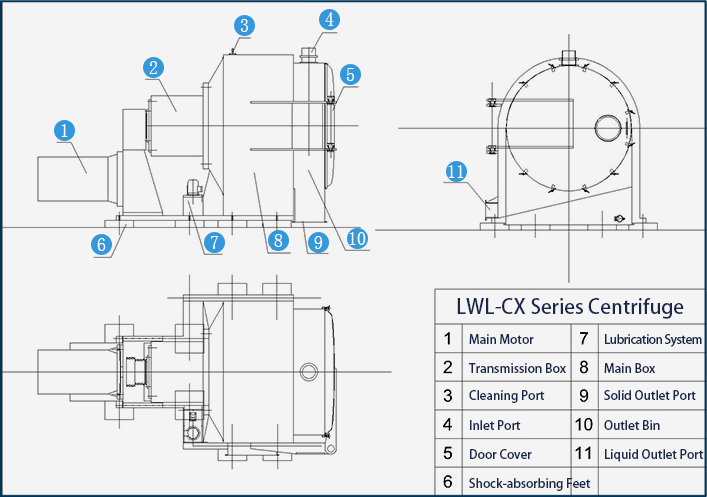
① Main Motor
⑦ Lubrication System
② Transmission Box
⑧ Main Box
③ Cleaning Port
⑨ Solid Outlet Port
④ Inlet Port
⑩ Outlet Bin
⑤ Door Cover
⑪ Liquid Outlet Port
⑥ Shock-absorbing Feet

Product Configurations
① Multiple materials available (304/316L/2205/titanium alloy/Hastelloy/zirconium, etc.).
② Optional interface form (tower interface/flange connection).
③ Optional motor brand, energy efficiency level, explosion-proof.
④ Optional cabinet explosion-proof, optional inverter, electronic component brand.
⑤ Optional screen style (laser screen/strip screen), material, mesh size.
⑥ Optional drum cone angle (0°/10°/20°).
⑦ Optional GMP requirements (stainless steel lining for the whole machine, screw and drum polishing).
⑧ Optional feeding method (feeding pipe feeding/screw conveyor feeding).
⑨ Optional vibration protection, shaft temperature detection.
⑩ Optional oxygen content detection, nitrogen filling protection system.
| Model | Drum Dia.(mm) | Drum Spd.(r/min) | Max.RCF | Feeding(m³/h) | Motor Power(kw) | Weight(kg) | Overall Dimension(mm) |
|---|---|---|---|---|---|---|---|
| LWL-CX-600 | 600 | 2000 | 1340 | 10-30 | 45 | 2500 | 2000X1300X1600 |
| LWL-CX-700 | 700 | 1700 | 1129 | 15-40 | 55 | 3000 | 2400X1400X1700 |
| LWL-CX-800 | 800 | 1500 | 1005 | 20-50 | 55 | 4500 | 2500X2200X2000 |
| LWL-CX-900 | 900 | 1400 | 985 | 30-60 | 90 | 7000 | 2800X1800X1900 |
| LWL-CX-1000 | 1000 | 1200 | 807 | 40-70 | 90 | 8000 | 3200X2000X2200 |
| LWL-CX-1100 | 1100 | 1000 | 615 | 50-80 | 110 | 10000 | 3550X2800X2650 |
| LWL-CX-1200 | 1200 | 900 | 543 | 50-100 | 110 | 11000 | 4000X2300X2400 |
| LWL-CX-1300 | 1300 | 900 | 588 | 80-150 | 137 | 12000 | 4200X2500X2600 |
| LWL-CX-1500 | 1500 | 800 | 536 | 150-300 | 250 | 14000 | 4900X2900X3000 |
| Adipic Acid | Ammonium Thiosulphate | Naphthenic Sulfonic Acid Ester | Date Stones | Salt Cake |
| Ion Exchange Resin | Sodium Nitre | Polystyrene Alcohol | Arsenic Triazole | Sodium Chloride |
| Sodium Perborate | Sodium Thiosulphate | Ah-salt | Anth Racene | Nylon Chips |
| Copper Sulphate | Greaves | Iron Sulphate Hepta Hydrate | Sodium Phosphate | Potash |
| Rock Salt | Citric Acid | Tarterci Acid | Aminoacetic Acid | Sodium Chlorate |
| Oxalic Acid | Crystal Soda | Gun Powder | Aspirin | Sodium Sulphate |
| Potash Alum | Regenerated Rubber | Lactose | Polymethacrylate | Tin Sulphate |
| Ammonium Persulphate | Sodium Formate | Sodium Sulphite | Dinitro Methylarlin | Gypsum |
| Bisphenol | Polysyrene | Potash Solvent Residue | Silver Nitrate | Manganese Sulphate |
| Sodium Tetraborate | Trisodium | Ammonium Phosphate | Sodium Gluconate | Two Nirto Methylaniline |
| Extraction From Methanol | Urotropin | Borax | Disodium Phosphate | Ammonium Sulphate |
| Methyl Cellulose | Potassium Lore | Potassium Bica Rbonate | Ammonium Sulphate | Sodium Metaborate |
| Potassium Chloride | Zinc Sulphate | Hops From Dichlorc Methare | Calcium Formiate | Polyvinyl Chloride |
| Potassium Bichromate | Monosod lumphasphate | Potassium Sulphate | Potassium Pensuphate | Sodium Ca Rbonate |
| Sodium Nitrate | Polyethylene | Fungal Mycel |

30 Year Brand
A Number of National Patents

Contact Us
Know More