Decoding the Horizontal Worm Screen Centrifuge
The Secret Weapon for Efficient Separation
Among the many types of centrifuges, the horizontal worm screen centrifuge has become the preferred equipment for separation, dehydration and unloading in many industries due to its high efficiency, continuity and automation. What is so unique about it? How does it work? This article will give you a deeper understanding of this “separation tool”.
01 Worm Screen Centrifuge: How it works
The Worm Screen Centrifuge is mainly composed of a drum, a screw, a base, a casing and other components. Its working principle is based on the action of the centrifugal field:
1. Feeding: The material enters the high-speed rotating drum through the feed pipe.
2. Separation: Under the action of the centrifugal field, the liquid phase is separated out through the metal screen installed on the drum wall, and the solid phase particles are retained in the drum.
3. Discharging: The solid phase particles in the drum move from the small end of the drum to the large end of the drum under the action of centrifugal force and the differential speed between the screw and the drum. During this movement, due to the increase in the rotating diameter, the centrifugal force increases rapidly, and the solid phase changes from a high liquid content solid phase at the initial entry to a low liquid content solid phase when it is discharged from the drum. The residue pushed out of the large end of the drum is discharged from the machine through the casing discharge port.
4. Liquid outlet: The separated liquid phase is discharged through the overflow port at the large end of the drum.
02 The advantages of the worm screen centrifuge
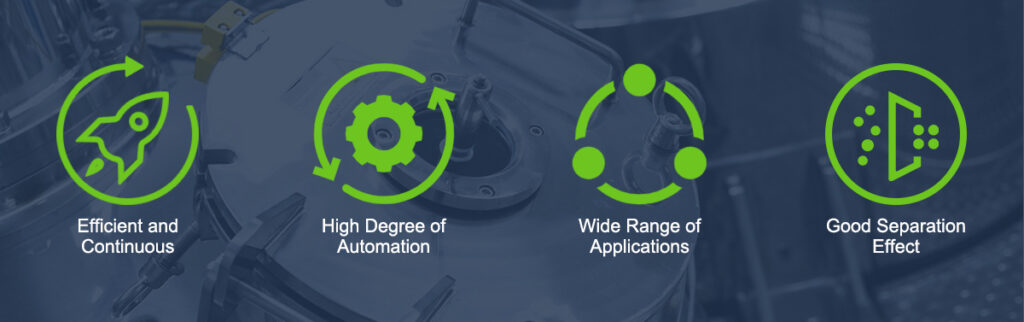
1. Efficient and continuous: It can achieve 24-hour continuous operation, large processing capacity and high separation efficiency.
2. High degree of automation: Automatic feeding, separation and discharging, reducing manual operation and labor intensity.
3. Wide range of applications: It can handle various solid suspensions containing coarse crystals and short fibers, and is suitable for chemical, food, pharmaceutical, mining and other industries.
4. Good separation effect: The appropriate mesh aperture can be selected according to the material characteristics to achieve efficient separation of solid and liquid phases.
03 The application of the worm screen centrifuge

1. Chemical industry: solid-liquid separation of ammonium sulfate, ammonium chloride, sodium chloride, sodium sulfate, etc.
2. Food industry: salt, etc.
3. Pharmaceutical industry: separation and dehydration of crystals such asantibiotics and vitamins.
4. Environmental protection industry: fibers, plastic particles, etc.
04 How to choose a suitable worm screen centrifuge?
The following factors should be considered when choosing a suitable worm screen centrifuge:
1. Material characteristics: including solid phase particle size, solid content, density, etc.
2. Processing capacity: Select the appropriate processing capacity according to production needs.
3. Separation requirements: Select the appropriate model according to the requirements for solid phase moisture content and liquid phase clarity.
4. Material requirements: Select the appropriate material according to the corrosiveness and hygiene requirements of the material.
05 Future Development Trends
With the advancement of science and technology, worm screen centrifuges will develop in the following directions:
1. Large-scale: meet the needs of large-scale production.
2. Intelligent: realize functions such as automatic control and remote monitoring.
3. Energy saving and environmental protection: reduce energy consumption and reduce environmental pollution.


30 Year Brand
A Number of National Patents

Contact Us
Know More